2. Building Survey in Relation to the Indoor Climate
This section details how a building is surveyed when excessive exposure levels of PCBs are suspected in indoor air. The building survey consists of a preliminary survey (e.g., comprising preliminary and a follow-up mapping).
The preliminary survey will clarify whether there is a PCB problem in the building and may form the basis for decisions on temporary abatement.
2.1 Preliminary Survey
The preliminary survey is typically conducted in steps:
- Historical building review
- Visual inspection of the building
- Preliminary mapping with sampling
- Follow-up mapping with more extensive sampling.
During the period 1950–1977, building materials containing PCBs may have been used. The historical building review comprises the year of building, materials used, maintenance work, and any renovations (see Section 4, Historical Building Review).
The aim of the review is to identify any risk of PCB-containing materials being used in the building. If the suspicion is confirmed, a visual inspection of the building is conducted. The inspection may include preliminary sampling.
If the building remains in the risk group after the visual inspection, mapping including sampling is required to confirm or disprove whether PCBs were used in the building, causing excessive exposure levels of PCBs in the indoor air. This mapping will typically be conducted in two steps. Initially, sampling will be performed to confirm or disprove the presence of PCBs. Next a more extensive mapping will be performed. Preliminary air samples and possibly material samples are collected.
If excessive exposure levels of PCBs in the air are suspected and may be causing adverse health effects, the survey of mapping PCBs in materials and indoor air conducted by Grontmij & COWI (2013) indicates that mapping can be most effective by first examining PCB concentrations in the indoor air. This method will also assist in determining problems with PCB content in the indoor air derived from capacitors or primary sources after they have been removed (Grontmij & COWI, 2013).
Air samples should indicate whether PCB concentrations in the indoor air are acceptable for user health. If concentrations are excessive, a survey with more air samples and material samples will follow. These surveys initially seek to clarify how extensive the indoor climate problem might be and what is causing it. Later in the process, it will likely be necessary to perform mapping for remediation. In this mapping work, building materials with PCBs will have to be identified and detailed to ensure the working environment and waste management.
Figure 10 illustrates the overall process of a building survey seeking to discover whether indoor air PCB concentrations are acceptable in terms of the recommendations issued by the Danish Health Authority.
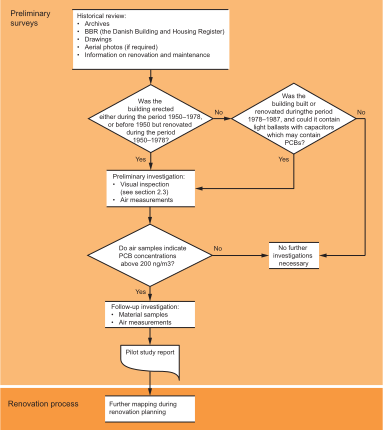
Figure 10. Schematic of the preliminary survey based on health-related conditions in a building.
Preliminary Survey Report
A report is made based on the preliminary survey. This report is based on the process described in Figure 10 and described in more detail in the following sections, including Section 4, Historical Building Review and Section 5, Mapping the Building Materials. The report will typically form the basis for decisions on temporary abatement interventions and the subsequent renovation process described in SBi Guidelines 242, Renovering af bygninger med PCB, 1 Renoveringsproces (Renovating Buildings Containing PCBs, 1 Renovation Process) (Andersen, 2013b).
Remediation does not necessarily include removal or handling of all the PCB-containing building materials identified. The procured documentation of building materials should be filed so that it can be referred to later (e.g., in connection with renovation or demolition).
2.2 Building History
The historical building review is intended to identify any risk of PCB-containing materials being used in the building. Section 4, Historical Building Review details how the historical building review can be performed.
2.3 Visual Inspection of the Building
The visual inspection should be based on an inspection of the building materials listed in Table 18 (Section 5.2, Construction Products Potentially Containing PCBs). It is necessary to establish whether there are (or have been) materials such as caulk, insulating glazing units, painted concrete floors in the building. Capacitors also feature on this list (see Section 5.2.4, PCBs in Capacitors). Capacitors manufactured up to 1986 may contain PCBs.
Provided that the building materials and capacitors can be dismissed as not present and the survey reveals that only ordinary wall paint was used, there will normally be little likelihood of PCB-contamination resulting in adverse health conditions for occupants. However, on the current basis of knowledge, it is not possible to obtain complete certainty without actual sampling of the air (see Section 1.6.1, Factors Affecting PCB Concentrations).
In old buildings in which materials potentially containing PCBs were added during the period 1950–1978, it will normally be necessary to collect air samples. This also applies to buildings where luminaires for fluorescent tubes were installed, which, until 1986, may contain capacitors with PCBs.
If capacitors are discovered in fluorescent light ballasts, or other applications where the capacitor may contain PCBs, it is recommended that capacitors or ballasts be removed (see Section 5.2.4, PCBs in Capacitors).
2.4 PCB Mapping in Relation to Indoor Air
Mapping is performed for the following purposes:
- To clarify whether there are PCBs present in the indoor air of a building
- To form a basis for assessing whether this has health implications
- To form a basis for an action plan which may include remediation
Mapping will initially direct focus at the indoor air quality and any health-related considerations are based on indoor-air PCB concentrations. How to collect air samples is described in Section 7, Determining PCB Content in Indoor Air, while the measuring strategy (i.e., where and how many samples to collect) is described in Section 2.5, Strategy for Air Sampling.
If the concentration in air samples exceeds 200 ng/m3, further surveys are necessary because it cannot be ruled out that the Danish Health Authority’s lower recommended action value of 300 ng/m3 has been exceeded (Danish Health Authority, 2013a) (see Section 1.3.5, Recommended Action Values and Section 9.2.1, Uncertainties). In the case of the working environment and occupancy of rooms where the indoor climate is polluted, the low action value for normal working hours is 1,200 ng/m3 (see Section 1.3.5, Recommended Action Values).
The next step is an inspection of the building materials and more systematic air measurements. The mapping process should be sufficiently thorough to assess the sources and ascertain the extent of the problem.
Mapping normally includes:
- An inspection and preliminary air measurements
- An assessment of the preliminary inspection and test results
- Repeated air measurements
- Comprehensive sampling of building materials which might identify several potential PCB sources
Methods for mapping materials with PCBs are described in Section 5.1, Scope of Mapping and Section 5.2, Construction Products Potentially Containing PCBs. Once the survey has been completed and the findings received, a report is prepared.
Later in the process, the case will proceed as a PCB renovation or demolition. Further mapping concerning the working environment and waste separation should be performed. The subsequent mapping is very thorough and is intended to identify all PCB sources which may be adding to the indoor climate problems. This facilitates the selection of remediation interventions and ensures that they work as intended. This kind of mapping is based on building materials as well as secondary and tertiary sources (which are described in Section 5.2, Construction Products Potentially Containing PCBs, Section 5.2.6, Secondary Contaminated Building Materials, and Section 5.2.7, Tertiary Contaminated Materials).
2.5 Strategy for Air Sampling
This section discusses how air samples should be collected and how many to collect. How to collect air samples is described in Section 7, Determining PCB Content in Indoor Air.
2.5.1 Number of Sampling Points
The variation in PCB concentrations in indoor air within a building can be considerable (see Section 1, Characteristics and Applications of PCBs) which is why air samples are collected in several places. Measurements should be done in both the leeward and windward sides of the building.
From what is known so far, the number of measuring points is a matter of judgment. Measurements should be made in at least two places. In dwellings, measurements are usually made in two locations per 100 m2 of floor space (e.g., two locations in a flat and two to three locations in a detached house). For larger buildings, measurements are made in five or more places. In the case of large areas or buildings with many rooms with different usages, measurements should also be made in several locations. In multi-storey residential buildings, measurements are evenly distributed on each storey.
2.5.2 Preliminary Measurements
When starting a survey to ascertain whether the indoor air in a building contains PCBs, it is usually unclear whether there is a PCB problem and where potential dominating sources are located. In this situation, measurements should be made in living spaces or rooms suspected of having particularly elevated values. This could include rooms with many caulked joints or many insulating glazing units, or rooms where spots have been observed below a light ballast with a capacitor that may have leaked PCBs. Newly renovated rooms and rooms not used as living spaces will typically not be selected.
Concurrently with the preliminary measurements, the building’s ventilation conditions are described. Table A.1 in Annex A, Ventilation Conditions, lists several ventilation conditions which should be checked on the first site visit.
2.5.3 Follow-up Measurements
Later in the process, more will be known about the PCB content of the materials. It will be necessary to factor in occupant exposure and to take measurements in living spaces or rooms subject to particular load. However, attempts should be made to measure under replicable conditions. Measuring sites which can be used repeatedly should be selected, so that PCB concentrations can be monitored over time in the same rooms.
Starting Conditions for a PCB Renovation Process
Regardless of the outcome of the further action plan, measurements are required which describe the situation prior to starting any temporary abatement and further action (see Section 9, Action Values and Temporary Abatement). Measurements should be conducted under replicable conditions to the extent that they can be used as a basis for subsequent assessment of the efficacy of various interventions.
Variation Over Time
Measurements should be taken repeatedly over time and at different outdoor temperatures because the outdoor temperature can affect both off-gassing from sources and ventilation conditions (see Section 1.6, PCBs in Indoor Air, Section 7.3.2, Influencing Factors, and Section 7.3.5, Temperature During the Sampling Period). As the research stands, how many times measurements should be performed is a matter of judgment.
Different Building Usage
Buildings may consist of several building segments built at different times. This means that some segments may contain PCBs while others do not (e.g., an extension to an existing school). In this situation, there may be a need to measure the indoor air in the uncontaminated parts of the building in connection with the temporary interventions (e.g., if ventilation conditions change). Furthermore, contaminated areas must be screened off so that occupants in areas without PCB-containing materials are not exposed to contaminated air.
Planning PCB Renovation
Following temporary abatement, it will be necessary to examine the efficacy of the temporary interventions. The result can be incorporated into the assessment of how extensive any subsequent renovation should be.
For example, after a thorough mapping process one may have uncovered all the primary sources and may have increased the ventilation of a building. However, one may have realised that this was far from sufficient to lower PCB concentrations to acceptable levels. A result like this indicates that the secondary and tertiary sources off-gas PCBs into the indoor air to a considerable extent, which suggests that managing these sources is necessary.
During PCB Renovation
If, during renovation, caulk is removed, PCB concentrations in the indoor air are very likely to rise (see SBi Guidelines 242, Renovering af bygninger med PCB, 2.2 Fysisk fjernelse (Renovating Buildings Containing PCBs, 2.2 Physical Removal) (Andersen, 2013b). In this situation, indoor-air measurements can be used to check whether any occupants elsewhere in the building are adequately protected.
After PCB Renovation
After the renovation, indoor-air PCB concentrations will be remeasured. Concentrations will not necessarily be lower than at the outset, as the handling of PCB-containing materials may increase contamination. It is therefore necessary to monitor PCB concentrations over time to ascertain whether an expected drop will take place.
If a method is used that does not remove PCBs from the building, it may be possible to achieve satisfactory PCB concentrations in the indoor air. However, monitoring will be required over time (years), as evidence concerning the long-term effect of various interventions is not yet available (see SBi Guidelines 242, Renovering af bygninger med PCB, 2 Afhjælpningsmetoder (Renovating Buildings Containing PCBs, 2 Remediation Methods) (Andersen, 2013b) and SBi Guidelines 242, Renovering af bygninger med PCB, 3 Beskyttelse af mennesker og miljø (Renovating Buildings Containing PCBs, 3 Protecting People and the Environment) (Andersen, 2013b)). Similarly, it is necessary to ensure that the remediation is implemented consistently and has the desired effect.