Appendix C. Joints
A face joint is the joint between two or more building components in a façade. A face joint can also designate the joint around a building component such as a window incorporated into a facade component or into a traditionally constructed exterior wall.
Figure C.1 shows face joints in a building structured from layered facade components of concrete and hollow-core deck components (Zachariassen et al., 1993).
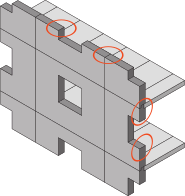
Figure C.1. Section of facade with marked face joints in concrete slab structure (Zachariassen et al., 1993).
Figure C.2 shows face joints in brick or brick-faced exterior walls around windows and doors.
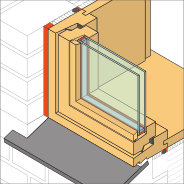
Figure C.2. Face joints in brick or brick-faced exterior walls with windows and doors (Zachariassen et al., 1993).
A face joint separates the interior and exterior as does the rest of the exterior wall. It is therefore affected by weather and the indoor climate. Two key principles apply when making facades rain and windproof: one-stage and two-stage sealed joints.
One-stage sealed joints provide both rain and wind proofing in one and the same joint (i.e., in a single impervious layer, usually flush with the façade). The sealant can be caulk, but also sealant tape or mortar (see Figure C.3).
The two-stage sealing method places rain and wind sealants in two separate layers with a pressure compensation chamber packed out with thermal insulation. Rainproofing can be achieved using sealant, but other materials are used (rubber profiles, mortar). A windproof and vapour-impermeable caulked joint is placed inside the joint (see Figure C.4).

Figure C.3. One-stage sealant joint between window casing and window rabbets. (Zachariassen et al., 1993)
- Rain and wind proofing caulk applied to the outer side of the window casing
- Bottom stop rail
- Mineral wool packing
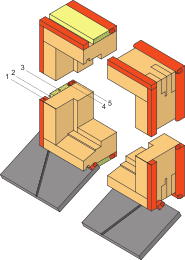
Figure C.4. Two-stage sealant joint between window casing and window rabbets. (Zachariassen et al., 1993)
- Rain shield on outer part of joint
- Pressure compensation chamber
- Mineral wool packing
- Bottom stop rail
- Windproof caulk.
Furthermore, there are two-stage sealant joints made up of two impervious layers packed with thermal insulation in between. In each of the two layers, the sealant is applied at the same level around the window. If the outer layer is rain and windproof, the joint will function as a one-stage sealed joint. The purpose of the inner layer is solely to prevent moist air from penetrating into the joint (Zachariassen et al., 1993).