3. Surveys Prior to Renovation or Demolition
Renovation and demolition generate construction waste. Therefore, it is important that environmentally harmful substances are identified, separated, and disposed of correctly.
This section describes the building surveys required prior to renovation or demolition. The building surveys are based on the Statutory Order on Waste, Chapter 13, Særlige regler om private og professionelle bygherrers identifikation af PCB i bygninger og anlæg og anmeldelse af affald (Special Rules for Private and Professional Building Owners’ Identification of PCBs in Buildings and Structures and the Notification of Waste) (Ministry of Environment, 2012).
On the Danish EPA website under Byggeaffald & anlægsaffald (Construction and Demolition Waste (CDW)) (www.mst.dk), there is a list of FAQs concerning the management of CDW and the legislative framework governing this waste (which comprises the Environmental protection Act, the Statutory Order on Waste (Affaldsbekendtgørelsen), and the Statutory Order on Recycling of Residual Products and Soil in Building and Construction Eork, and on the Recycling of Sorted, Unpolluted CDW (Restproduktbekendtgørelsen)).
This provides information on who is responsible for separating CDW and what local authorities may consider important when deciding whether to classify CDW as hazardous waste.
3.1 Screening
3.1.1 Screening Requirements
Prior to renovation or demolition, building owners must ascertain whether there is a risk of PCBs presence in the building or in parts of it. In the Statutory Order on Waste, the term ’screening’ is used and the screening should uncover whether materials potentially containing PCBs may have been used during the building or renovation of a building or structure. See the Statutory Order on Waste, Chapter 13, Særlige regler om private og professionelle bygherrers identifikation af PCB i bygninger og anlæg og anmeldelse af affald (Danish Ministry of the Environment, 2012).
The requirement for screening applies to construction work involving renovation or demolition of buildings or structures (or parts of these) erected or renovated during the period 1950–1977. However, renovation or demolition must comprise more than 10 m2 of the building or structure or must produce more than 1 ton of waste. The requirement for screening also applies when replacing insulating glazing units possibly manufactured during the period 1950–1977 (see Figure 11).
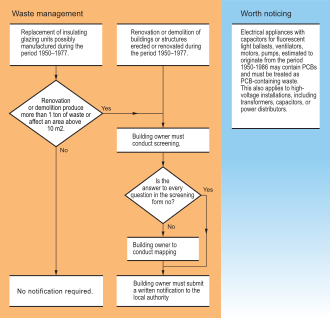
Figure 11. Schematic overview of when the rules of the Statutory Order stipulate when the local authority should be notified of renovation or demolition of a building or structure (erected or renovated during the period 1950–1977) and whether building owners are duty-bound to screen and map PCBs in the building or structure. Replacing insulating glazing units possibly manufactured during the period 1950–1977 is also subject to screening requirements.
The requirement for separating out PCBs is not subject to a lower threshold limit. Only screenings, mapping, and notification requirements operate with lower threshold limits. This means that requirements for separating out PCB-containing materials and insulating glazing units apply to all who generate CDW, regardless of the amount or extent of construction work.
Regardless of whether the screening requirement assumptions are met, waste-generating enterprises must (pursuant to the Statutory Order on Waste, Chapter 10, § 65 on Erhvervsaffald og kildesorteret erhvervsaffald egnet til materialenyttiggørelse (Industrial Waste and Recoverable Waste Sorted at Source) always separate hazardous waste, PCB-containing waste, and insulating glazing units from their CDW (Ministry of Environment, 2012).
Thus, no lower threshold limit exists for waste-generating enterprises regarding the separation of PCBs. According to Chapter 11, Særlige regler om farligt affald fra virksomheder (Special Rules for Hazardous Waste), hazardous waste must always be separated out and managed separately (Ministry of Environment, 2012).
Private households are also required to separate out hazardous waste, PCB-containing waste, and insulating glazing units via their duty to use municipal schemes for CDW, enabling households to separate according to sorting requirements in § 65, (1) and (2) (fractions), cf. § 35.
Construction work concerning several buildings or structures must be assessed together (see § 78, (2) in the Statutory Order on Waste). If the work is subject to the provisions of § 78, a screening form must be completed, available from Annex 11 of the Order (Ministry of Environment, 2012). If not all answers to the questions in the form are no, the building owner must conduct mapping of those parts of the building or structure which may contain PCBs (see § 79 in the Statutory Order on Waste). Thereafter, the local authority must be notified of the expected waste.
Chapter 13 in the Statutory order on waste also covers the notification of waste from buildings not erected or renovated during the period 1950–1977. This applies if renovation or demolition includes more than 10 m2 or generates more than 1 ton of waste. However, this scenario is outside the scope of this book.
If a worker or contractor, has agreed to dispose of PCB-containing waste from households, this is no longer considered households waste, but industrial waste (www.pcb-guiden.dk). Industrial waste is waste (including CDW) generated by enterprises (Ministry of Environment, 2012).
3.1.2 Purpose of Screening
A screening will uncover whether a building contains building materials that may have been produced with PCBs. If potential primary sources are identified, the next step is to collect samples to clarify whether PCBs are present. If chemical analyses show that PCBs are present, the possible migration to adjacent materials and deposits on surface areas in relation to the construction waste generated should be considered. PCBs from construction products with an admix of PCBs during production (primary sources) may have migrated into adjacent building materials (secondary sources) and off-gassed into the indoor air. PCBs off-gassed into indoor air can be deposited over time. This contaminates interior surface areas (tertiary sources) in the building (see Section 1.5, Primary, Secondary, and Tertiary Sources). This includes electrical appliances with PCB-containing components which may have leaked PCBs (e.g., capacitors in lighting ballasts).
The degree of contamination of adjacent building materials and surface areas will vary. However, if the indoor air has been subjected to significant contamination, surface areas and furnishings are very likely to contain PCBs to an extent that requires special management as construction waste. Screening should also uncover whether PCB-containing building materials were used previously and have polluted other materials. If windows with PCB-containing sealant around the window casings have been replaced, there will very likely be PCBs in the adjacent building materials. This means that the adjacent materials may emit PCBs to the new caulked joints which, in turn, will be contaminated.
Insulating glazing units produced during the period 1950–1977 may potentially contain PCBs and may later have been replaced. This could mean that remaining window casings might be contaminated. Light fixtures or other electrical appliances (possibly with PCB-containing components) may have been replaced, potentially leaking PCBs to the indoor air. It can be a difficult task to ascertain whether they contained capacitors and whether these have caused contamination. If this is suspected, collecting samples from potential tertiary sources may be necessary to clarify whether pollution has occurred.
3.2 What Would Trigger a Screening?
3.2.1 Conditions for Completing a Screening Form
A screening form must be completed when renovation or demolition includes buildings or structures (or parts of these) erected or renovated during the period 1950–1977 and:
- when the renovation or demolition involves more than 10 m2 or the work generates more than 1 ton of waste
- when insulating glazing units potentially manufactured during the period 1950–1977 are due for replacement
3.2.2 Erected or Renovated between 1950 and 1977
PCBs were used in building materials from approx. 1950 until 1 January 1977 when PBCs were banned in open applications (see Section 1.8, Rules). Section 4.1.1, Year of Construction and Renovation History describes how information on year of construction and renovation can be obtained.
3.2.3 Area Larger than 10 m2
The duty to screen will be triggered if the building or structure was erected or renovated during the period 1950–1977 and the planned work involves more than 10 m2 of a building or structure.
3.2.4 More than 1 Ton of Waste
The screening duty will be triggered if the building or structure was erected or renovated during the period 1950–1977 and if this work will generate more than 1 ton of waste.
Weight of Construction Waste
The total amount of construction waste will, depending on the floor area, be approx. 1.0–1.8 t per m2 in general house construction and up to 2.0 t per m2 in industrial construction (Lauritzen & Jacobsen, 1991).
For renovation work, the total weight is calculated based on the separate structures to be removed. This determines whether the weight of the construction waste will total 1 ton and thus meet the requirements for screening, notification, etc.
Table 9. Approximate density of typical building materials.
Building Material | Weight kg/m3 | Weight kg/m2 |
|---|---|---|
Plastered brick wall, interior partition wall (12 cm thick) | 1,700 | 200 |
Concrete partition wall (10 cm thick) | 2,400 | 240 |
Plastered breeze-block wall (10 cm thick) | 1,500 | 150 |
Tiling (5 mm adhesive, 5 mm plaster) | 2,000 | 20 |
Tiled floor (12 mm adhesive, 8 mm mortar) | 2,200 | 40 |
Concrete floor, terrazzo (50 mm) | 2,400 | 120 |
Ceiling cladding, wall cladding, soft sheets, on timber battens | 400 | 10 |
Floorboards, coniferous wood (24 mm) | 600 | 15 |
Based on figures from Table 9, Table 10 shows examples of the weight of construction waste from different building structures and materials.
Table 10. Examples of the estimated weight of construction waste.
Building Structure | Weight, kg |
|---|---|
Demolition of plastered brick wall, approx. 12 cm thick, 4 m long, and 2.5 m high (200 kg/m2 × wall area 10 m2) | 2,000 |
Demolition of interior concrete partition wall, approx. 10 cm thick, 4 m long, and 2.5 m high (240 kg/m2 × wall area 10 m2) | 2,400 |
Bathroom* (3 m wide, 2 m long): Pulling down tiling from floor to a height of 1.5 m, less door and window area (20 kg/m2 × 13 m2) = 260 kg Removing floor tiles (40 kg/m2 × 2 m × 3 m) = 240 kg | 500 |
* removal of sink, toilet, and possibly bathtub not included.
These examples show that removing a partition wall will necessitate screening while removing tiles from ceiling and walls in a 6 m2 bathroom will not.
3.2.5 Insulating Glazing Units
PCBs were used in sealants for Danish-produced insulating glazing units until 1977 and in certain foreign glazing units until 1980. PCBs may also have been used in mounting materials for insulating glazing units (see Section 1.4.5, Insulating Glazing Units). In some glazing units, the year of production is stamped onto the aluminium strip between the glazing units (see Section 5.2.2, PCBs in Insulating Glazing Units).
In relation to the Statutory Order on Waste and the identification of waste polluted by PCBs, checks should also be made to see whether glazing units dating from the period 1950–1977 have been replaced, as these might have contaminated the window casing and any residual material.
The Danish EPA has published Vejledning om håndtering af PCB-holdige termoruder (Guidelines on Managing PCB-Containing Insulating Glazing Units) (Danish EPA, 2014), addressing building owners, enterprises involved in demolition and renovation, municipalities, hauliers, recipients, and processors of PCB-containing waste. The guidelines outline relevant legislation and the requirements relative to the individual actors. Moreover, it provides concrete recommendations for collecting samples and interpreting results.
3.3 Screening Form
3.3.1 Purpose and Structure
The aim of the screening is to clarify whether the building or structure contains building materials or electrical appliances potentially produced with PCBs. Hence, the screening will clarify whether sample collection and chemical analysis of materials are necessary. The screening implies that the screening form in Annex 11 of the Statutory Order on Waste is completed (Ministry of Environment, 2012). The screening form should be followed by a visual inspection of the affected building.
The screening form has two parts: one for buildings and one for structures. For buildings, the form has seven yes or no questions focusing on building materials containing PCBs. Furthermore, the form draws attention to electrical appliances as a possible source of PCB-containing waste. For structures, three yes or no questions are listed. This section includes building-related structures only.
The form addresses elastic and plastic caulk because PCBs were used in this type of caulk during the period 1950–1976 in all types of building. Elastic caulk is soft or hard and its shape will be restored (e.g., when tooled with a spatula). A completely plastic caulked joint will retain the shape sustained by the deformation (see Section 1.4.4, Caulking Compound).
The screening result decides whether mapping should be conducted, but a notification of waste should be performed. The content of the notification will depend on the screening result.
3.3.2 Screening Form Questions
Table 11 shows the questions in the screening form concerning buildings (Ministry of Environment, 2012) and explains why the question is relevant and how to find the answers.
Table 11. Questions in the screening form concerning buildings, with explanatory note. The form is available from Annex 11, the Statutory Order on Waste (Ministry of Environment, 2012).
Questions on the Screening Form Regarding Buildings
Explanatory Note
Question: Does the building contain elastic caulked joints around doors and windows possibly dating back to the period 1950–1977?
Note: PCBs were used in both elastic and plastic caulk and so the caulk in the interface between door frames and walls must be inspected.
Although the present caulk may have been applied during renovation carried out after the ban on PCBs in caulk, it may be contaminated due to contact with materials that were contaminated by old PCB-containing caulk (PCBs may have migrated from the original caulk into adjacent building materials). This must be considered when assessing the waste.
Question: Does the building contain elastic caulked joints at the interface of facade or wall units possibly dating back to the period 1950–1977?
Note: PCBs were used in both elastic and plastic caulk and joints should therefore be checked (see explanatory note to the first question above). Table 17 in Section 5.2, Construction Products Potentially Containing PCBs states where elastic and plastic caulk were typically placed.
Question: Does the building contain elastic caulked joints as expansion joints between building units possibly dating back to the period 1950–1977?
Note: PCBs were used in both elastic and plastic caulk and joints should therefore be checked (see explanatory note to the first question above). Table 17 in Section 5.2, Construction Products Potentially Containing PCBs states where elastic and plastic caulk were typically placed.
Question: Does the building contain insulating glazing units (windows with sealed double-glazing) possibly dating back to the period 1950–1977?
Note: PCBs may have been used in sealants and mounting materials for glazing units. In certain foreign glazing units, these may have been used up to 1980. In some insulating glazing units, the production year is stamped on the aluminium strip between the glazing units (see Section 5.2.2, PCBs in Insulating Glazing Units). If glazing units potentially containing PCBs has been replaced (see Section 5.2.2, PCBs in Insulating Glazing Units) the window casing may also be contaminated even though the glazing units are new. This must be considered when assessing the waste.
Question: Does the building contain paint possibly dating back to the period 1950–1977?
Note: Many buildings erected or renovated during the period in question contain paint and these buildings are therefore subject to the requirement for mapping. PCBs in paint do not necessarily have functional relevance. Although PCB concentrations are typically low, it is important that they are classified as PCB-containing for construction waste management.
Materials with PCB concentrations above 0.1 mg/kg were discovered in more than 75 % of the buildings surveyed from the period 1950–1977 (Grontmij & COWI, 2013) and many of the samples came from paint (see Section 1.4.3, PCBs in Building Materials).
Considerable amounts of PCBs were admixed to certain types of paint during production to obtain specific properties. These paints were typically applied in places requiring high resilience to abrasion and weather. These include balconies and access balconies, interior stairwells, washrooms, storage rooms, basement bike storage rooms, and boiler rooms. The paint may have been applied to floors, walls, soil stacks, and metal railings (see Section 5.2.3, PCBs in Paint).
It may be necessary to make a visual check of the painted surfaces and to scrape off some paint to determine how many layers of paint there are and whether some of the underlying layers may date from the period 1950–1977. Please note the age of the wall, as partition walls erected later than 1977 may misleading the investigation.
Question: Does the building contain flooring compound potentially dating from the period 1950–1977?
Note: Self-levelling flooring compounds with PCBs were frequently used in Norway. However, in Denmark PCB-containing such flooring compounds have, thus far, only been detected in industrial and office buildings and a few multi-storey residential buildings (see Section 5.2.5, Other Materials Containing PCBs). In the buildings surveyed from the period 1950–1977 (Grontmij & COWI, 2013), about half of the flooring compound samples indicated PCB concentrations above 0.1 mg/kg (see Section 1.4.7, Flooring Compound and Flooring)
Question: Does the building contain other materials suspected of containing PCBs?
(If YES, specify the materials)
(If YES, specify the materials)
Note: Table 17 (in Section 5.2, Construction Products Potentially Containing PCBs) lists materials which may contain PCBs according to building type. In multi-storey residential buildings and industrial and office buildings, PCB waste was discovered in tile adhesive in floors and walls. Waterproofing materials and waterproofing primers with PCBs were used in wet rooms, utility rooms, and kitchens. There may be PCBs in sealant tape for windows, doors, by partition walls, between slabs/units, or beams. Thermal putty with PCBs may also have been used around outlets. Flooring such as linoleum may have been produced with admixed PCBs or fixed using adhesives containing PCBs. The materials may have been wholly or partly replaced, which must be considered when assessing the waste.
Question: Moreover, please note that electrical appliances with capacitors e.g. fluorescent light ballasts, ventilators, motors, pumps, plus high-voltage installations, including transformers, capacitors, or power distributions estimated to date from the period 1950–1986 may contain PCB and should be managed as PCB-containing waste.
Note: In 1986, all imports and sale of PCBs was banned regardless of application (Ministry of Environment, 1986). Requirements stipulate that transformers of more than 2 kVAr and capacitors weighing more than 1 kg be disposed of by 1 January 2000 at the latest (Ministry of Environment, 1998). Smaller capacitors and transformers were permitted to be used for the remainder of their lifespans. Capacitors are described in detail in Section 5.2.4, PCBs in Capacitors.
The screening form also specifies three questions regarding structures (e.g., bridges and roads) but not plants. These Guidelines only address building-related structures. The questions are stated in Table 12 along with explanatory notes.
Tabel 12. Screeningsskemaets spørgsmål vedrørende anlæg i relation til bygninger med uddybende vejledning. Skemaet findes i affaldsbekendtgørelsen, bilag 11 (Miljøministeriet, 2012).
Questions Regarding Structures
Explanatory Text
Question: Does the structure contain elastic caulk possibly dating from the period 1950–1977?
Note: A review of drawings or a visual inspection may be necessary to determine whether there may be caulk potentially containing PCBs.
Question: Does the structure contain paint potentially dating from the period 1950–1977?
Note: A visual inspection may determine whether there is paint but will not determine whether the paint dates from the period 1950–1977. It is therefore necessary to obtain more detailed descriptions of the structure.
Question: Does the structure contain other materials
suspected of containing PCBs (if YES,
specify these materials).
suspected of containing PCBs (if YES,
specify these materials).
Note: Table 17 in Section 5.2, Construction Products Potentially Containing PCBs list materials which may possibly contain PCBs according to building type.
3.3.3 Screening Result
If the answer to one or more questions in the form is ”yes”, mapping of the building or structural parts which may contain PCBs must be conducted (pursuant to § 79 of the Statutory Order on Waste). If the answer to all the questions in the form is ”no”, the local authority must be notified of the waste (in accordance with § 81 of the Statutory Order on Waste) (see Section 3.5, Notifying Waste).
3.4 Mapping
3.4.1 Purpose of Mapping
Mapping focuses on building materials which become waste and is typically a stepwise process. The first step is to collect samples to confirm or disprove the presence of PCBs. The aim of mapping is to:
- Clarify whether there are PCBs in the affected parts of the building.
- Form a basis for separating out materials with PCBs, the correct separation of waste, and waste disposal.
Mapping underpins the assessment of health and safety issues during the work (see also SBi Guidelines 242, Renovering af bygninger med PCB, 3 Beskyttelse af mennesker og miljø (Renovating Buildings Containing PCBs, 3 Protecting People and the Environment) (Andersen, 2013b).
Furthermore, mapping will ensure that the renovation will not affect the indoor climate of the building negatively due to PCBs.
PCB content in building materials must be determined quantitatively to determine whether the waste fraction constitutes hazardous waste, waste for incineration or landfill, or recoverable waste (see Section 3.5.4, Classifying Waste, and SBi Guidelines 242, Renovering af bygninger med PCB, 4 Affaldshåndtering (Renovating Buildings Containing PCBs, 4 Waste Management)) (Andersen, 2013b).
4.2 Scope of Mapping
Mapping usually includes:
- Introductory sampling of materials
- Assessment of test results
- Follow-up mapping with more extensive material sampling (e.g., including secondary and tertiary sources)
Mapping will be based on those building materials constituting the primary sources of PCB contamination and those secondary and tertiary sources relevant to the specific renovation or demolition (see Section 5.1.2, Renovation or Demolition?). This could include the renovation of wet rooms in a housing complex where building materials containing PCBs might have been used in wet rooms and would be in focus. This is described further in Section 5.2, Construction Products Potentially Containing PCBs, Section 5.2.6, Secondary Contaminated Building Materials, and Section 5.2.7, Tertiary Contaminated Materials.
The mapping strategy (i.e., where and how many samples should be collected) is described for individual building materials in Section 5, Mapping the Building Materials and the methodology for sampling is detailed in Section 8, Determining PCB Content in Building Materials.
Once the survey has been completed and the test results received, a report is prepared and attached to the notification to the local authority in accordance with § 82 of the Statutory Order on Waste.
In the case of renovation, please consider the effect of the renovation on the building and whether PCB-containing building materials may adversely affect health conditions in the building (see Section 5.1.2, Renovation or Demolition?).
3.5 Notification of Waste
3.5.1 Timely Notification
Prior to commencing demolition or renovation, the local authority should be notified of waste.The notification of waste should be submitted concurrently with the application or notification according to building regulations, or no later than two weeks before commencing the building work (Ministry of Environment, 2012). The notification varies relative to the screening result. Many local authorities use notification forms (see e.g. the City of Copenhagen website, www.kk.dk).
3.5.2 Screening and No Mapping
If the answer to all questions in the screening form is ”no”, the authority should be notified of waste in accordance with § 81 of the Statutory Order on Waste. The Statutory Order lists 8 items that the local authority needs to know at minimum.
If the answer to all the questions in the screening form is “no”, it is recommended that the notification be supported (e.g., with drawings or a photo of the building work) (City of Copenhagen, 2014).
3.5.3 Screening and Subsequent Mapping
If the screening prompts mapping, the authority must be notified according to § 82 of the Statutory Order on Waste, which lists 14 items that the local authority needs to know at minimum. Items 8 to 11 can be answered using the mapping results.
Notification is based on a mapping of the building as is and accounting for the destructive actions which can readily be made. In some cases, when the demolition of the building as a whole or in part commences, further materials will be discovered which should be surveyed for PCBs (e.g., caulk near partition walls). Such potential occurrences should be considered in the notification.
The amount and types of PCB-containing waste must be estimated, which means that the definition of fractions, cleaning requirements, and waste classification must be clarified. When CDW is sorted for recovery, care must be taken that everything except for mortar and reinforcement iron has been separated (see § 65 (4) in the Statutory Order on Waste) (Ministry of Environment, 2012). This means that PCB-containing caulk and other materials containing PCBs must be identified and separated out (Danish EPA, 2011, Ministry of Environment, 2012) (see SBi-anvisning 242, Renovering af bygninger med PCB, 4.3.1 Affaldsproducerende virksomheder (Renovating Buildings Containing PCBs, 4.3.1 Waste-Producing Enterprises)) (Andersen, 2013b).
How the waste is classified is decided by the local authority. This could be hazardous waste, recoverable waste, waste for incineration, or landfill (see SBi Guidelines 242, Renovering af bygninger med PCB, 4.3.3 Klassificering af affald (Renovating Buildings Containing PCBs, 4.3.3 Classifying Waste)) (Andersen, 2013b). For waste to be classified correctly in a specific municipality, the information should be obtained from the municipality's website or by contacting them.
Table 13 states items 8–14 in the notification form in § 82 of the Statutory Order on Waste. Items 1–7 concern data on the building owner and property. An explanatory note accompanies each item.
Table 13. Notification of waste.
Item in the Notification According to § 82
Explanatory Note
- Item: Test results of representative material samples and a description of the visual assessment underlying the sampling.
Note: The mapping will be part of the information. Depending on the extent and complexity of each case, it can be difficult to estimate whether sampling is representative.
- Item: Presence and number of PCB-containing materials.
Note: Occurrences are estimated based on mappings of the PCBs in the building materials. All PCB-containing materials removed from the building must be calculated. The materials are classified based on PCB concentrations measured during the mapping process and in accordance with the local authority’s guidelines for disposal. Thus, individual building materials are subdivided into waste for destruction, incineration, landfill, and recovery. Thereafter, the weight of the specific building materials in each class is estimated.
Hazardous waste with a PCB content greater than 50 mg/kg is notified separately (see Section 3.1.1, Screening Requirements). For caulk containing PCBs, the total amount (in metres) of caulk is calculated and the weight is estimated (see example below).
For secondary sources (e.g., contaminated concrete around window sealant with PCBs to be cut out) an estimated weight is given based on window casing measurement, depth of PCB migration into the concrete, dimension of material removed, and expected concrete density (see examples below, Section 3.5.5, Calculating the Amount of Waste Containing PCBs).
For PCB surface contamination, the amount of waste should be estimated based on method of removal (see SBi Guidelines 242, Renovering af bygninger med PCB (Renovating Buildings Containing PCBs)) (Andersen, 2013b). If wooden floors or gypsum walls are not stripped, the estimated weight of the building materials should be calculated by m2 and an estimated weight per m2 (see examples below, Section 3.5.5, Calculating the Amount of Waste Containing PCBs).
- Item: Location of PCB-containing materials supported by picture or drawing if unclear.
Note: This item can be fulfilled by conducting mapping with a clear description of marking or sampling sites. This can be achieved by marking sampling sites on a ground plan, indicating which material has been sampled (e.g., caulk, paint, or flooring). Furthermore, photographs of the sampling site could be used to meet this requirement. Finally, the actual spot can be marked.
- Item: How PCB-containing materials have been identified by labelling, signage, or other measures.
Note: The marking of materials containing PCBs is often executed in the planning phase prior to commencing the work (see SBi Guidelines 242, Renovering af bygninger med PCB (Renovating Buildings Containing PCBs)) (Andersen, 2013b). The description is intended to explain how renovation or demolition workers obtain the information required to enable the correct handling of waste and could be a description of how the separate surfaces (walls, ceilings, floors) are marked, partly to indicate what action has been taken (clean-up or removal) and, partly to specify the waste classification.
- Item: Specific plans to remove and manage PCB-containing materials.
Note: The description is intended to set out how PCBs are separated from the waste for recovery and which building materials will be sent for destruction, incineration, or landfill. This means that the waste needs to be classified. Moreover, details on how to safeguard the working environment and how the various waste classes are stored on site to avoid mixing them up should be given (see SBi Guidelines 242, Renovering af bygninger med PCB, 3 Beskyttelse af mennesker og 4 Affaldshåndtering (Renovating Buildings Containing PCBs, 3 Protecting People and 4 Waste Management) (Andersen, 2013b).
- Item: Test results of representative material samples and a description of the visual assessment underlying the sampling.
Note: This is calculated based on item 9. The calculated amounts of waste in each class should be added up.
- Item: Expected treatment or recovery of the waste or the expected recipient of the waste.
Note: PCB-containing waste is, as a rule, either sent for landfill or destruction (Danish EPA, 2011). The local authority in question will specify how to handle the PCB-containing waste (Danish EPA, 2011).
3.5.4 Classifying Waste
Item 13 (Expected amounts and types of waste) and item 14 (Expected treatment or recovery of the waste or the expected recipient of the waste) are linked to the decisions under item 12 on how to remove PCB-containing waste. Therefore, building owners have to clarify item 12 in collaboration with the local authority before the
notification can be completed.
According to the POPs Regulation, the basic assumption for managing waste containing PCBs is that a reasonable effort is made to avoid waste being polluted by POPs. Furthermore, waste containing POPs must be destroyed as a matter of principle. In the case of large, unmanageable fractions of construction waste (e.g., concrete containing less than 50 mg/kg of PCBs) the waste can be sent to landfill. Table 14 states the definition and management of PCB waste based on PCB concentration.
PCB Concentration | Definition of Waste | Management |
|---|---|---|
≥ 50 mg PCB/kg | Hazardous waste | Destroyed at approved incineration plant or sent to subterranean landfill (abroad). |
< 50 mg PCB/kg | Non-hazardous waste | Non-hazardous waste should be sent for destruction at a plant approved to destroy waste containing PCBs but can be sent for landfill if it is difficult to handle (e.g., concrete). The Danish EPA estimates that, assuming that all the remaining conditions stipulated in the Statutory order on the landfill of waste (Deponeringsbekendtgørelsen) are met, landfilling of PCB-containing waste should be executed as follows: |
Waste with a PCB content of less than 1 mg/kg can be deposited at landfills for inert waste. | ||
Waste with a PCB content of between 1 and 50 mg/kg can be deposited at landfills for mineral or mixed waste. | ||
If waste containing PCBs is deposited at landfills for inert waste, PCB content will be sufficiently low for the Danish EPA not to recommend depositing the PCB-containing waste at separate enclosures in these landfills. | ||
If PCB-containing waste is deposited at a landfill for mineral or mixed waste, the Danish EPA recommends that waste containing PCBs be deposited in separate enclosures where it can be localised later. | ||
Can be regarded uncontaminated by PCBs | Non-hazardous waste | Until a national limit value has been determined for when PCB concentrations in waste are low enough to be regarded as uncontaminated, the Danish EPA refers to the PCB guidelines prepared by the City of Copenhagen. In these guidelines, construction waste containing PCBs is regarded as uncontaminated when concentrations are below 0.1 mg PCB/kg. The Danish EPA emphasises that (notwithstanding the City of Copenhagen’s guidelines and according to the Statutory Order on Waste) it is the duty of individual local authorities to assess whether construction waste can be regarded as unpolluted. |
Construction waste with a PCB concentration low enough to be considered unpolluted is reused as sand, grit, and gravel according to the rules in the Statutory order on recycling of residual products and soil in building and construction work and on the recycling of sorted, unpolluted CDW (Restproduktbekendtgørelsen) (if all the other conditions stipulated by the order are met). |
Table 14. Definition and management of PCB waste based on PCB concentration (www.pcb-guiden.dk).
The concentration of PCBs in waste is determined according to guidelines set out by DS/EN 15308 (Danish Standards, 2008b).
The local authority will determine how waste should be managed. The City of Copenhagen classifies waste as stated in Table 15.
Table 15. Concentration values for PCB-containing construction waste and break-down into polluted and hazardous waste (City of Copenhagen, 2014).
Waste Type | PCB Content (total) |
|---|---|
Polluted waste for incineration or landfill | 0.1-50 mg/kg |
Hazardous waste | > 50 mg/kg |
If a building contains PCBs in parts to be renovated or demolished, it is the starting point within the City of Copenhagen (2014) that PCBs on hard surfaces (e.g. concrete) should be cleaned up whereas for wood this is not required.
3.5.5 Calculating the Amount of Waste Containing PCBs
All materials containing PCBs that are removed from a building must be listed and specified. The amount is estimated based on the mapping (of PCBs in the building materials), which also informs classifications:
- Individual building materials are subdivided into waste for destruction, incineration, landfill, and recovery.
- The weight of the building materials is estimated in each class (e.g., based on knowledge of the density of concrete, wall thickness, weight of gypsum panels, etc).
Examples
For caulk produced with PCBs, the total length of caulked joints (m) is calculated, and the weight is estimated by calculating or estimating the weight of caulk per metre. If the caulk weighs 20 g/m (Gunnarsen et al., 2009) and is located around a window casing measuring 120 cm × 130 cm, there will be approx. 100 g of caulk per window.
If there is a PCB surface contamination, a decision should be made as to whether clean-up is required. If a wooden floor or gypsum wall is not cleaned up before being demolished, an estimated weight of the building materials is calculated based on area in m2 and estimated weight per m2. The classification is often relative to PCB concentrations in the surface area.
For secondary contamination of concrete (e.g., around an interior door) the contaminated concrete will typically be cut out. If possible and in consideration of the working environment, attempts will often be made to cut to a distance where the concrete can be regarded as uncontaminated. The distance is determined based on chemical analyses of cores or as a ”worst case” scenario (see SBi Guidelines 242, Renovering af bygninger med PCB (Renovating Buildings Containing PCBs)) (Andersen, 2013b). If chemical analyses indicate that PCB content drops to below 0.1 mg/kg in the concrete at a distance of 5 cm from the joint, the cut will usually be made 5 cm in.
If PCB concentrations in the concrete adjacent to the caulk are above 50 mg/kg, it is classified as hazardous waste. Figure 12 shows a door opening where approx. 5 cm of the concrete adjacent to the caulk around the door frame has been cut out.
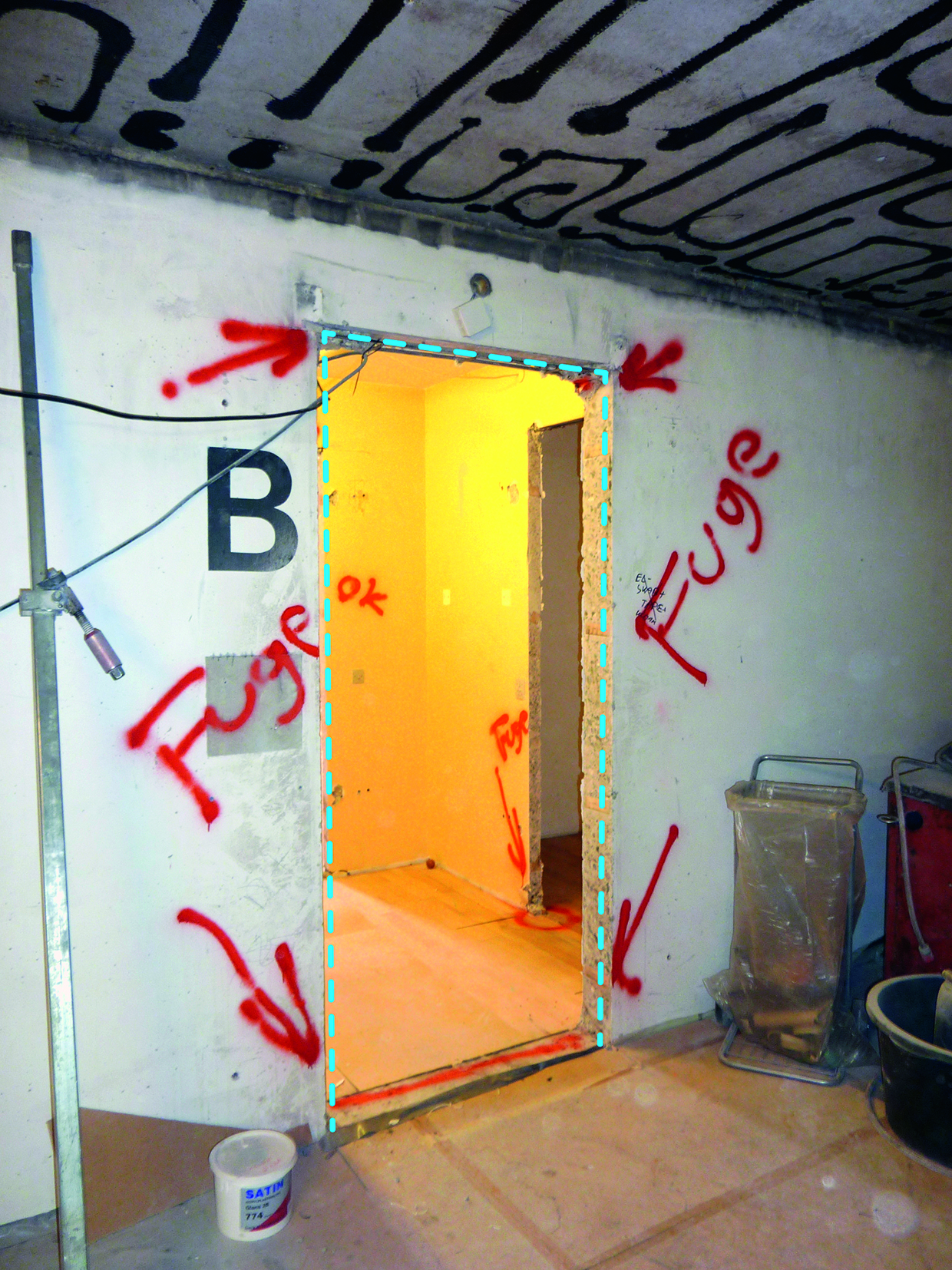
Figure 12. Illustration of concrete cut out around a door with caulk containing PCBs
If the cut is made 5 cm from where the primary source was and the wall thickness is 6 cm, the height and width of the door frame measure 210 cm and 80 cm, respectively, and the piece above the door frame in the corners measures 2 × 5 cm, the volume of contaminated concrete to be cut out is approx. (210 + 5 + 80 + 5 + 210) cm × 6 cm × 5 cm = 15,300 cm3. The density of the concrete is assumed to be 2,300 kg/m3 (i.e., the material cut out will weigh approx. 35 kg).
If, say, there are five interior doors and the caulk samples collected around the doors indicate that the same caulk has been used throughout, if the density of the concrete is the same in all walls near the doors, and if it is anticipated that the adjacent material around the doors is contaminated in the same way, cutting out the concrete around the five doors will generate 5 × 35 kg = 175 kg of hazardous waste.