Introduction
PCBs were used legally as plasticisers and fire retardants in many building materials between approx. 1950–1977 (Danish EPA, 1983). In the 1960s, while investigating the occurrence of the insecticide DDT in the natural environment, traces of PCBs were discovered (Jensen et al., 1969). It was evident that PCBs, like DDT, are accumulated through the food chain. Today, PCBs are banned and feature on the EU’s list of harmful substances, on which it is designated as among the persistent organic pollutants (POPs).
PCBs in building materials may have affected indoor air to an extent that is adverse to human health. PCBs were also used in certain types of electric equipment (e.g., capacitors used in fluorescent light ballasts until 1986) (Danish EPA, 1983, 2015).
According to the Statutory Order on Waste, special requirements apply when disposing of PCB-contaminated waste. Managing PCB-containing materials also requires special health and safety measures.
Several issues may necessitate testing for PCBs in a building. This publication describes how to test for and assess PCBs in buildings suspected of having:
- Indoor air with excessive and unhealthy PCB concentrations due to PCBs in building materials.
- PCB-contaminated materials which may generate PCB-containing waste due to renovation or demolition.
Tests are required to clarify these issues. The basis for testing for PCBs in a building is identical in both cases.
Testing for PCBs in a building will typically take place in a sequence of steps. First, the suspicions are clarified, and samples are mapped to confirm or disprove any reasonable suspicions. Second, further mapping is carried out as well as sample testing. Test results provide a basis from which to act (see Figure 1).

Figure 1. The recommended testing process to clarify the presence of suspected PCBs, mapping to confirm or disprove reasonable suspicions, and subsequent mapping(s) to facilitate action.
This publication describes how to identify buildings in the risk group and map the presence of PCBs by measuring PCB concentration in indoor air and/or testing building materials.
Aspects of health are assessed based on indoor air PCB measurements and the action values stipulated by the Danish Health Authority or the Danish Working Environment Authority (WEA). This book provides suggestions on how to initiate immediate abatement.
Regarding whole or partial renovation and demolition of buildings, the publication follows the Statutory Order on Waste, Chapter 13, Særlige regler om private og professionelle bygherrers identifikation af PCB i bygninger og anlæg og anmeldelse af affald (Special Rules for Private and Professional Building Owners’ Identification of PCBs in Buildings and Structures and the Notification of Waste) (Danish Ministry of Environment, 2012), with requirements for screening, mapping and notification of PCB-containing waste.
This book describes mapping, including PCB sampling in indoor-air and/or building materials. There are several mapping levels, depending on the starting point and timing of the tests.
This book complements SBi Guideline 242, Renovering af bygninger med PCB (Renovating buildings containing PCBs) (Andersen, 2013b), which outlines the primary PCB management issues which arise in renovation projects. SBi Guideline 242 covers choices and options when abating PCBs in the indoor climate or separating out PCBs while also safeguarding the working environment, occupants, and the external environment.
Structure of the Guidelines
Section 1, PCBs – Properties and Applications, explains why PCBs constitute a problem for the building and construction sector. The section details commercial PCB products and the physico-chemical and toxic properties of PCBs. Furthermore, the section provides an overview of building materials which may contain PCBs and the consequences of PCB content in building materials for indoor air quality. Finally, the section provides an overview of existing and former rules governing this topic.
Section 2, Building Survey in Relation to Indoor Climate addresses building surveys when excessive levels of PCBs are suspected in indoor air. Mapping is performed by collecting air samples which are assessed based on the action values for PCB content in indoor air (stipulated by the Danish Health Authority or the Danish WEA).
Section 3, Surveys Prior to Renovation or Demolition is based on requirements in the Statutory Order on Waste for screening, mapping, and notifying authorities of PCB-containing waste prior to a renovation or demolition of a building.
Section 4, Historical Building Review details how to review the building history based on the year of construction and any renovation and maintenance work carried out since construction.
The purpose of detailing the building history is to determine the risk that PCB-containing materials were used in the building. If a building is in the risk group, it will be necessary to determine whether there are health issues and/or whether there are PCB-containing materials subject to the Statutory Order on Waste.
Section 5, Mapping the Building Materials describes the mapping of PCBs in building materials. The extent of the mapping is detailed, partly based on health concerns relating to PCBs and indoor air, and partly on the identification of PCBs prior to the generation of construction waste to ensure that it is managed correctly. The section details which building materials may potentially contain PCBs and their likely locations.
Section 6, Chemical Analyses addresses the information and analytical tests required, as well as the role of testing laboratories in the process.
Section 7, Determining PCB Content in Indoor Air explains how to collect indoor air samples to determine PCB concentrations.
Section 8, Determining PCB Content in Building Materials describes how to collect samples from building materials to determine PCB content.
Section 9, Action Values and Temporary Abatement describes how to compare measurements of PCB concentrations in indoor air using recommended action values from the Danish Health Authority and the Danish WEA and how to implement temporary abatement.
Some background knowledge, issues, and investigations are applicable in multiple contexts, irrespective of whether an investigation is intended to manage health or waste concerns. There are sections in the Guidelines addressing both positions while others are only relevant to a specific topic. Figure 2 is a schematic illustration of the structure of the Guidelines.
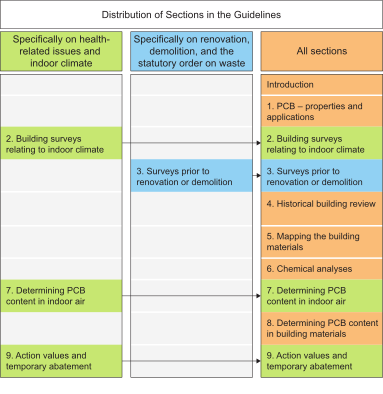
Figure 2. Schematic overview of the sections in the Guidelines. Sections with specific relevance to surveys related to health assessments or to the statutory order on waste (renovation or demolition) are marked as such.
Reading Instructions
We assume that users of these Guidelines have the necessary technical knowledge and are aware of the problems associated with measurements.
There will be repetitions in the text, as the Guidelines are intended as a reference work. Table 1 lists some questions and where to find the answers in the Guidelines.
Table 1. Reading instructions.
What are PCBs? | ► | Sections 1.1, 1.2, and 1.3 |
|---|---|---|
Where were PCBs used? | ► | Sections 1.4 and 1.5 |
Which rules apply? | ► | Section 1.8 |
Which surveys are necessary when adverse health conditions are suspected due to PCBs? | ► | Section 2 |
Which surveys are necessary prior to renovation or demolition? What is the significance of the statutory order on waste? | ► | Section 3 |
Which buildings may contain PCBs? | ► | Section 4 |
How are PCBs mapped in materials and in which materials were PCBs used? | ► | Section 5 |
Which requirements are chemical analyses subject to? | ► | Section 6 |
How are air samples collected? | ► | Section 7 |
How are material samples collected? | ► | Section 8 |
What are the recommended action values for PCB concentrations in indoor air? | ► | Section 9.1 |
How are PCB concentrations in indoor air assessed relative to recommended action values? | ► | Section 9.2 |
Which types of temporary abatement interventions can be implemented? | ► | Section 9.3 |
Definitions
This section lists definitions of several specialist terms and concepts used in the Guidelines.
Waste
Waste in the context of the Guidelines includes waste contaminated by PCBs through removal, demolition, renovation, or operational and maintenance work.
Remediation
Remediation includes one or more measures implemented to mitigate PCB exposure levels in indoor air relative to building occupants. The remediation can be temporary (i.e., typically implemented immediately after identifying a PCB problem and before actual renovation or demolition work is begun). If the remediation includes measures which do not remove the PCB source, but solve the indoor climate problem, in this context it is regarded as temporary until the PCB contamination has been physically removed from the building.
Action Values
Action values specify a concentration of PCBs in indoor air. If PCB concentrations exceed the action value, action is required. The Danish Health Authority has issued recommended action values for indoor-air PCB concentrations. The Danish Health Authority has attached different recommendations to these action values. The Danish WEA has also defined action values with recommendations for their supervisors.
The recommended action values stipulated by the Danish WEA do not cover health and safety issues associated with renovation or demolition work involving the handling of PCB-containing materials (see SBi Guidelines 242, Renovering af bygninger med PCB (Renovating Buildings Containing PCBs) (Andersen, 2013b) or the Danish WEA (2014)).
Analysis
Analysis refers to chemical analysis determining and quantifying the presence of PCBs in a sample.
Structures
Structures include bridges, roads, and open spaces for example, but do not include plants (see the screening form in the statutory order on waste (Ministry of Environment, 2012)).
Building Portfolio
A building portfolio includes the buildings owned by a municipality or property company.
Limit of Detection
The limit of detection is the lowest concentration determinable by chemical analysis. Testing laboratories may define limits of detection differently. Please check the definition used by specific testing laboratories. Often, a limit of detection is reported as three times the standard deviation of the blanks or test samples with low concentrations.
Preliminary Survey
In this context, the aim of a preliminary survey is to identify whether the PCB content in the indoor air of a building is excessive. It can form the basis for decisions on temporary abatement. Preliminary surveys conclude with a report.
Joints
A joint is the space between building components, but it also refers to the actual sealing of joints. Joints can be power-transmitting in which case they are executed in cement or lime mortar. Sealed joints can also be non-power-transmitting, but capable of absorbing the movements that may occur in surrounding building components. In relation to PCBs and building materials, focus is directed at non-power-transmitting joints.
Concentration
Concentration is the relative amount of a substance contained in a mixture of substances.
Concentrations in air samples are often reported as the mass of a substance in a specific volume of air. In these Guidelines, the mass of PCBs in 1 m3 of air is used. Concentrations in building material samples are reported as the mass of the substance compared to the total mass of the sample. It can be reported as a mass fraction or weight fraction. Unless otherwise stated, it refers to the total amount of PCBs. The total amount of PCBs is determined by chemical analysis of selected PCB congeners, 'indicator PCBs' (see Section 1.1.4, Indicator PCBs), adjusted by a correction factor. For air samples, this factor is 5. For building material samples, the factor is relative to the content of different PCB congeners compared with the product type. If the sample does not match a product type, the factor is 5.
Mapping
Mapping is a systematic inspection of a building comprising sampling, which facilitates the identification of building materials potentially containing PCBs or provides information on PCB content in indoor air. Mapping can have varying degrees of detail depending on whether it is a preliminary or follow-up mapping.
Measurement
Measurement is used in several contexts. It is possible to measure PCB content in indoor air by sampling the air and subsequently subjecting it to extraction and chemical analysis. A measurement can also be the actual chemical quantification of one or more substances in a sample.
Material Recovery
Material recovery comprises reuse, recycling, or material recovery of construction and demolition waste (CDW). Recovery is a general concept, including both material recovery and energy recovery (e.g., incineration).
Demolition
Demolition of buildings or building parts. This is the general term for waste-generating activities where building assemblies or structures are taken down and removed (see SBI Guidelines 171, Nedrivning af bygninger og anlægskonstruktioner (Demolishing buildings and structures) (Lauritzen & Jakobsen, 1991)).
Partial Demolition
Partial demolition is the removal of structural parts and building materials to a limited extent. Selective demolition is a demolition method chiefly concerned with methodical separation, removal, and storing of waste materials (see SBI Guidelines 171, Nedrivning af bygninger og anlægskonstruktioner (Demolishing buildings and structures) (Lauritzen & Jakobsen, 1991)).
Sampling
Sampling can be done by collecting parts of building materials or indoor air. Samples are subsequently sent for processing and chemical analysis at a laboratory.
Renovation
Renovation refers to the reconditioning a property to modern standards. Renovation may also be the result of functional changes of the building or a wish to reduce the building’s energy consumption, for example. Renovation includes conversions and extensions and the replacement of components like windows and floors. Renovation involves interventions or the removal of parts of existing buildings.
Screening
Screening is a requirement of the Statutory Order on Waste that is triggered if specific conditions are met (see Section 3.2, What Would Trigger a Screening?). Screening is carried out by completing a screening form which is detailed in Annex 11 of the Statutory Order on Waste (Ministry of Environment, 2012).